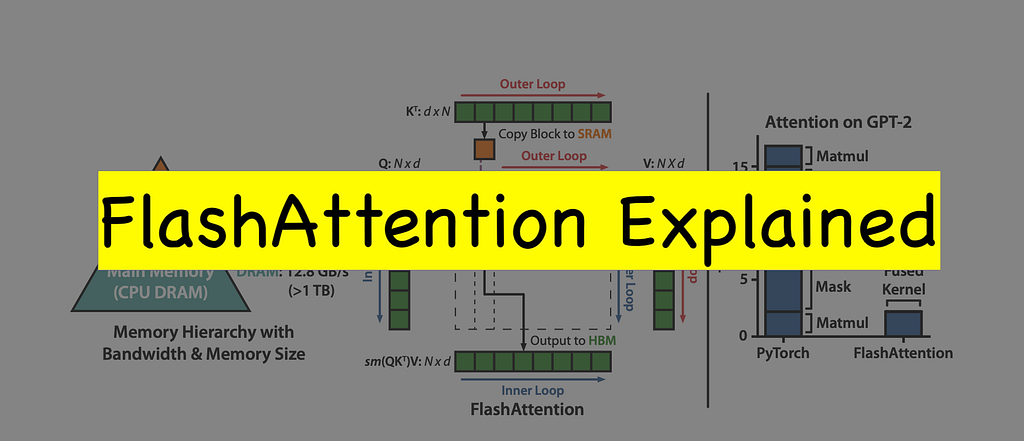
Source: Image by the author.
In the fast-evolving landscape of large language models, the quest for faster and more efficient models is unending. Recently, a revolutionary concept in the world of LLMs has gained significant attention, FlashAttention. This concept, often referred to as FlashAttention V1, is a technique that promises to significantly accelerate the training of LLMs on GPUs.
In this blog post, we’ll delve into the intricacies of FlashAttention, its core concepts, and the reasons why it’s considered an advancement in GPU acceleration for deep learning models.
A Quick Recap
Before we dive into the details of FlashAttention, let’s recap some essential concepts related to GPU architecture and deep learning. In Part 1 of the FlashAttention series, we explored the data flow from hard disk to main memory to GPUs. We also discussed various terminologies used in GPUs and explored the concept of memory hierarchy. If you need a more detailed explanation, it’s recommended to go through Part 1 of the series.
Additionally, understanding how self-attention works in Transformers is crucial. Self-attention, a fundamental operation in Transformers, has an inherent time and memory complexity of O(n²). To grasp the significance of FlashAttention, it’s essential to have a solid foundation in these concepts. If you need a more detailed explanation, it’s recommended to go through this video.
What Is FlashAttention?
Flash Attention is a breakthrough in optimizing the attention mechanism, a pivotal component of Transformer-based models. The attention mechanism is responsible for learning the relationships between different parts of input sequences. In traditional self-attention, the time and memory complexity is O(n²), which can be a major bottleneck in training deep learning models.
FlashAttention, on the other hand, offers an alternative approach that promises to be 3x faster than traditional self-attention. It does so by leveraging the power of GPU architecture and making efficient use of the tensor cores or CUDA cores. In fact, FlashAttention V2 claims to be 2x faster than its predecessor, potentially making it up to 6x faster than standard attention mechanisms.
The Core Concepts of Flash Attention
The magic of FlashAttention lies in its core concepts, namely tiling and recomputation. These concepts work together to reduce the need to read and write attention weights to and from the high-bandwidth memory (HBM) of GPUs. Let’s take a closer look at these two mechanisms:
-
Tiling: Tiling involves splitting the Q (Query), K (Key), and V (Value) matrices into smaller blocks or chunks. These blocks are loaded into the faster on-chip SRAM (Static Random-Access Memory) and processed at the block level, reducing the need for frequent memory access to the HBM.
-
Recomputation: Recomputation, on the other hand, is utilized during the backward pass, which is crucial for training LLMs. Instead of reading the attention weights from HBM for backpropagation, FlashAttention recomputes the weights efficiently in the on-chip SRAM, which is significantly faster. This increases the number of floating-point operations (flops) but reduces the number of memory accesses thereby reducing wall-clock time
Kernel Fusion: Enhancing Efficiency
Kernel Fusion is another key element that contributes to the efficiency of FlashAttention. It involves combining multiple functions into a single function (kernel) executed on CUDA cores. This fusion of functions reduces the need for multiple memory accesses and enhances the overall efficiency of the model.
Training Speed and Quality
One of the advantages of FlashAttention is its impact on training speed. Training LLMs, giants such as GPT-2 and GPT-3, becomes significantly faster with FlashAttention. In some cases, the training speed has improved by up to 15%, making it a valuable tool for researchers and developers.
Furthermore, FlashAttention enables the training of models on longer sequences. Longer sequences can lead to higher-quality models, and this is a significant advantage when aiming for state-of-the-art results in various natural language processing tasks.
Limitations and Future Prospects
While FlashAttention V1 presents an advancement in GPU acceleration for deep learning, it has its limitations. Some challenges include the lack of explicit functions for targeting CUDA and the need for multi-GPU support. However, ongoing research and the emergence of FlashAttention V2 are likely to address many of these limitations.
Conclusion
FlashAttention is a remarkable advancement in the world of deep learning. Optimizing the attention mechanism, reducing memory access, and accelerating training speeds, opens new doors for researchers and developers looking to push the boundaries of LLMs.
To get a more in-depth understanding of the concepts discussed in this post, be sure to check out the following video
In Part 3 of this series, we will take a deep dive into the Flash Attention algorithm, examining its intricacies, implementation details, and practical applications