Google released the Gemma 3 technical report and it shows real progress in open weights AI. Instead of focusing only on scale, Gemma 3 is built around efficiency. It can handle much longer context, understand images better and run faster on hardware.
This post explains the main technical decisions behind Gemma 3 and why they matter.
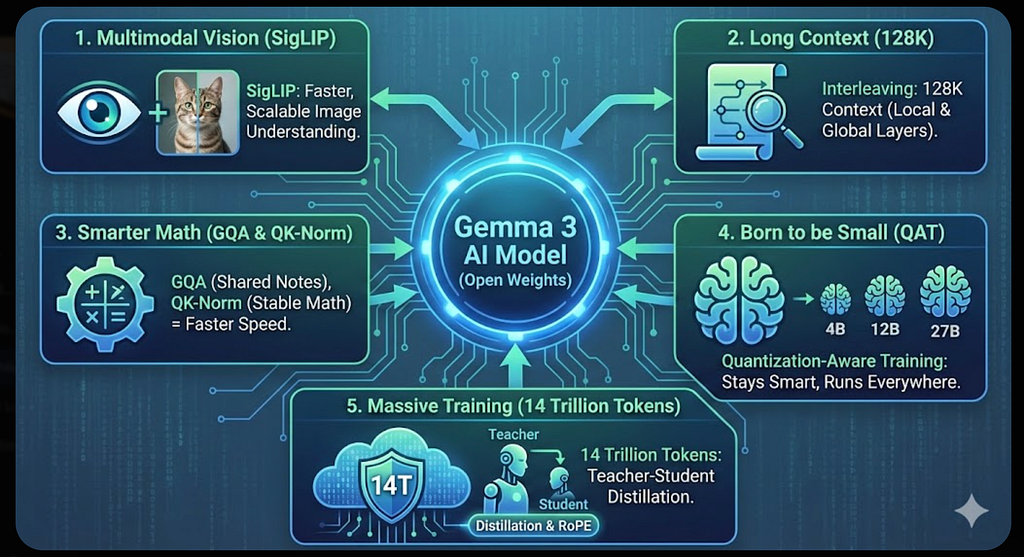
created using Nano Banana
Multimodal Architecture: Why SigLIP Trumps CLIP
Gemma 3 is a native multimodal LLM, but it moves away from the traditional CLIP-based approach. Instead, it utilizes the SigLIP (Sigmoid Language-Image Pre-training) architecture
The Scalability Secret: Unlike CLIP, which uses a contrastive loss requiring all image-text pairs to be calculated (softmax), SigLIP uses a sigmoid loss. This treats the task as a series of binary outcomes, making it significantly easier to scale.
Breaking the Context Barrier: 128K with Interleaving
Handling a 128K context window is computationally expensive. In standard decoder-only LLMs, every token must “see”every previous token at every layer, leading to massive slowdowns.
Gemma 3 solves this with Interleaving Methods:
Local Layers: These focus on a limited window (e.g., the last 1024 tokens) to maintain high speed.
Global Layers: These layers look at the entire 128K context.
The Ratio: To balance performance and speed, Gemma 3 places one global layer for every five local layers.
The Efficiency Engine: GQA and QK-Norm
Gemma 3 introduces two major changes to how the model processes information to speed up inference without sacrificing accuracy.
Grouped-Query Attention (GQA)
Gemma 3 utilizes Grouped-Query Attention. As explained in the deep-dive video, GQA is the “sweet spot” between Multi-Head Attention (high quality, slow) and Multi-Query Attention (fast, lower quality).
Replacing Soft-Capping with QK-Norm
Gemma 2 uses “soft-capping” to prevent attention scores from exploding by passing them through a tanh function. While effective, it added mathematical overhead at every step.
QK-Norm (Query-Key Normalization): Gemma 3 standardizes the Q and K vectors before they are multiplied. By ensuring they have a mean of 0 and specific variance, it prevents the “Softmax collapse” more efficiently, making the model faster during generation.
Training at Scale: 14 Trillion Tokens
-
Dataset: Trained on 14T tokens.
-
Tokenizer: Uses a SentencePiece tokenizer with a massive 262K vocabulary. It preserves whitespace and uses byte-level encodings to handle multilinguality and code more effectively.
-
Distillation: The model utilizes a teacher-student distillation process where the student model learns from 256 logits per token, effectively using the teacher’s “mini-map” of probabilities to accelerate learning.
Quantization-Aware Training (QAT)
Most models are trained in high precision and then “quantized” later (i.e., Post-Training Quantization), which often causes a “precision shock” that drops accuracy. But Gemma 3 uses QAT:
-
The “Fake Quantization” Loop: During training, the model rounds weights in the forward pass but uses high-precision math in the backward pass. Yes, during traning there are 2 copies of models stored: one with quantised & one without!
-
The Result: The model is able to handle low-precision environments, ensuring that the different versions remain highly accurate even when running on consumer hardware.
Post-Training and RL: BOND, WARM, and WARP
The final “polish” of the model involves advanced Reinforcement Learning (RL) phases based on improved versions of BOND, WARM, and WARP.
-
Focus Areas: These reward functions are specifically tuned for helpfulness, math, coding, and reasoning.
-
Context Scaling: Rather than training at 128K from day one, the models are pre-trained at 32K and then “upscaled” to 128K at the very end using RoPE (Rotary Positional Embeddings) rescaling.
Conclusion
Gemma 3 focuses on smarter design rather than increasing model size
Resources
-
Gemma 3: https://arxiv.org/abs/2503.19786
-
Gemma 2: https://arxiv.org/abs/2408.00118
-
Gemma 2 explained: https://huggingface.co/blog/gemma2